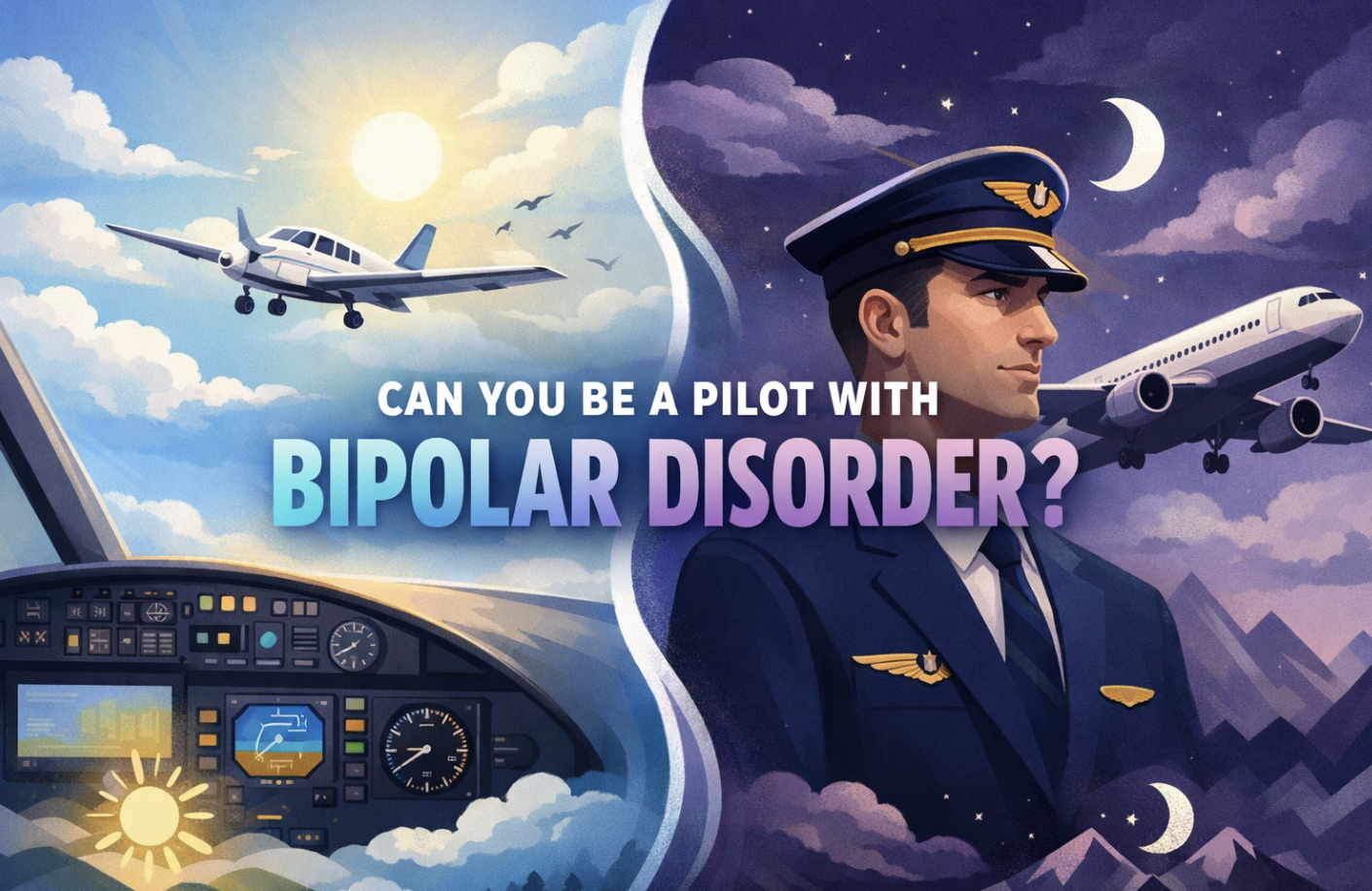
Becoming a pilot requires meeting strict medical and psychological standards designed to ensure flight safety. One of the most closely assessed areas is mental health, particularly conditions that can affect judgement, mood stability and cognitive performance.
Bipolar disorder, also known as bipolar affective disorder, involves periods of elevated mood (mania or hypomania) and episodes of depression. Because of the potential for sudden mood shifts and impaired decision-making, aviation authorities around the world generally classify bipolar disorder as a condition that may prevent someone from holding a pilot medical certificate.
This article explains how bipolar disorder is treated under aviation regulations for both private pilots and commercial pilots, and explores why aviation’s approach may be out of step with broader workplace mental health policies.
Private Pilots and Bipolar Disorder
United States (FAA)
In the United States, pilots must hold a medical certificate issued by the Federal Aviation Administration (FAA). The FAA’s medical standards specifically address psychiatric conditions, including bipolar disorder.
According to the FAA’s Guide for Aviation Medical Examiners, bipolar disorder is considered a condition that typically results in denial or deferral of a medical certificate, regardless of severity. The FAA notes that even well-managed cases can involve unpredictable mood or cognitive changes that may affect flight safety.
You can review the FAA’s guidance on bipolar disorder and psychiatric evaluations for pilots on the FAA medical certification page.
Private pilots applying for a Class 3 medical certificate (used for recreational and private flying) must disclose any diagnosis of bipolar disorder and any psychiatric medications. In rare circumstances, the FAA may review extensive psychiatric documentation under its special issuance process, but approvals for bipolar disorder are uncommon.
More detail on how mental health conditions affect FAA pilot medicals can be found through aviation medical resources such as Airmappr’s mental health certification guide.
Australia (CASA)
In Australia, the Civil Aviation Safety Authority (CASA) oversees aviation medical standards. CASA requires pilots to disclose all mental health conditions during their medical assessment.
Bipolar disorder is listed as a condition that requires formal evaluation by a Designated Aviation Medical Examiner (DAME) and often specialist psychiatric input. CASA’s medical guidelines indicate that disorders involving mood instability are likely to impact certification because of the potential effects on concentration, judgement and stress tolerance.
CASA’s official guidance on mental health conditions for pilots is available through its aviation medical assessment framework.
While Australia introduced the Class 5 self-declaration medical for some recreational pilots, bipolar disorder remains one of the conditions that generally disqualifies a person from self-certifying. More explanation of these changes can be found in CASA recreational medical updates.
Europe (EASA)
Across Europe, pilot medical standards are governed by the European Union Aviation Safety Agency (EASA).
EASA regulations require that pilots must not suffer from any psychiatric condition that could interfere with the safe operation of an aircraft. Bipolar disorder is usually considered incompatible with certification unless extensive evidence demonstrates long-term stability with minimal risk.
Further background on how psychiatric conditions are assessed under EASA can be found through aviation mental health assessment resources.
Commercial Pilots and Bipolar Disorder
Commercial pilots face significantly higher medical standards due to the complexity of operations and responsibility for passenger safety.
Across major aviation authorities — including the FAA (USA), CASA (Australia) and EASA (Europe) — bipolar disorder is generally treated as a condition that is:
- Disqualifying by default, or
- Subject to extremely strict case-by-case review with no guarantee of approval
The FAA explicitly lists bipolar disorder as a psychiatric condition that typically prevents certification for professional pilots. CASA similarly requires detailed psychiatric assessment, with certification often being declined due to risk considerations.
EASA’s medical rules also require that commercial pilots be free from any mental disorder that could affect reliability or judgement, which usually excludes individuals with bipolar disorder.
In practical terms, pursuing a commercial aviation career with a bipolar diagnosis is extremely difficult, with only rare exceptions.
Why the Aviation Industry Takes a Strict Approach
Safety as the Primary Concern
Aviation medical standards are based on risk prevention, not just current functioning.
Unlike most workplaces, a pilot experiencing sudden impairment could place:
- Passengers
- Crew
- People on the ground
at risk within minutes.
Regulators therefore aim to minimise the chance of any condition that could lead to sudden incapacitation or impaired judgement, even if that risk is relatively low.
CASA outlines this precautionary approach in its aviation medical assessment philosophy.
Mental Health Inclusion vs Aviation Regulation
In most modern workplaces, mental health conditions are protected under anti-discrimination laws, and employers are encouraged to provide support rather than exclude individuals.
Many industries now recognise that:
- Bipolar disorder can be effectively managed with medication, therapy and lifestyle stability
- Many people with bipolar lead high-functioning professional lives
However, aviation regulation has not fully evolved alongside contemporary mental health treatment models.
Investigations have highlighted that strict aviation medical policies may unintentionally discourage pilots from seeking help. For example, reporting by Reuters has shown that some pilots hide mental health struggles for fear of losing their medical certification.
This creates a tension between:
- Safety-driven regulation
- Modern workplace mental health inclusion standards
Critics argue that aviation may be behind the times in how it balances risk with evidence-based mental health management.
Are There Any Exceptions?
In limited cases, aviation authorities may consider certification if an applicant can demonstrate:
- Long-term stability (often many years)
- No recent manic or depressive episodes
- Comprehensive psychiatric evaluations
- In some cases, no ongoing psychiatric medication
In the U.S., this is handled through the FAA’s special issuance medical certificate process. In Australia and Europe, it involves specialist assessments and regulator review.
However, approvals for bipolar disorder remain rare.
Some forms of flying — such as ultralight or recreational aircraft in certain jurisdictions — may not require a formal medical certificate, but these are exceptions and vary by country.
Final Answer: Can You Be a Pilot With Bipolar Disorder?
Private Pilot
In most countries, bipolar disorder usually prevents obtaining a standard private pilot medical certificate. Rare exceptions may exist following extensive assessment, but approval is uncommon.
Commercial Pilot
For commercial aviation, bipolar disorder is almost always considered disqualifying under current regulations.
The Bigger Picture
While aviation’s strict medical standards are rooted in safety, they stand in contrast to broader workplace trends that promote mental health inclusion and non-discrimination.
As treatment outcomes for bipolar disorder continue to improve, there is growing discussion around whether aviation medical policies should eventually shift toward:
- More individualised risk assessment
- Recognition of well-managed mental health conditions
For now, however, the industry continues to apply a highly precautionary approach.