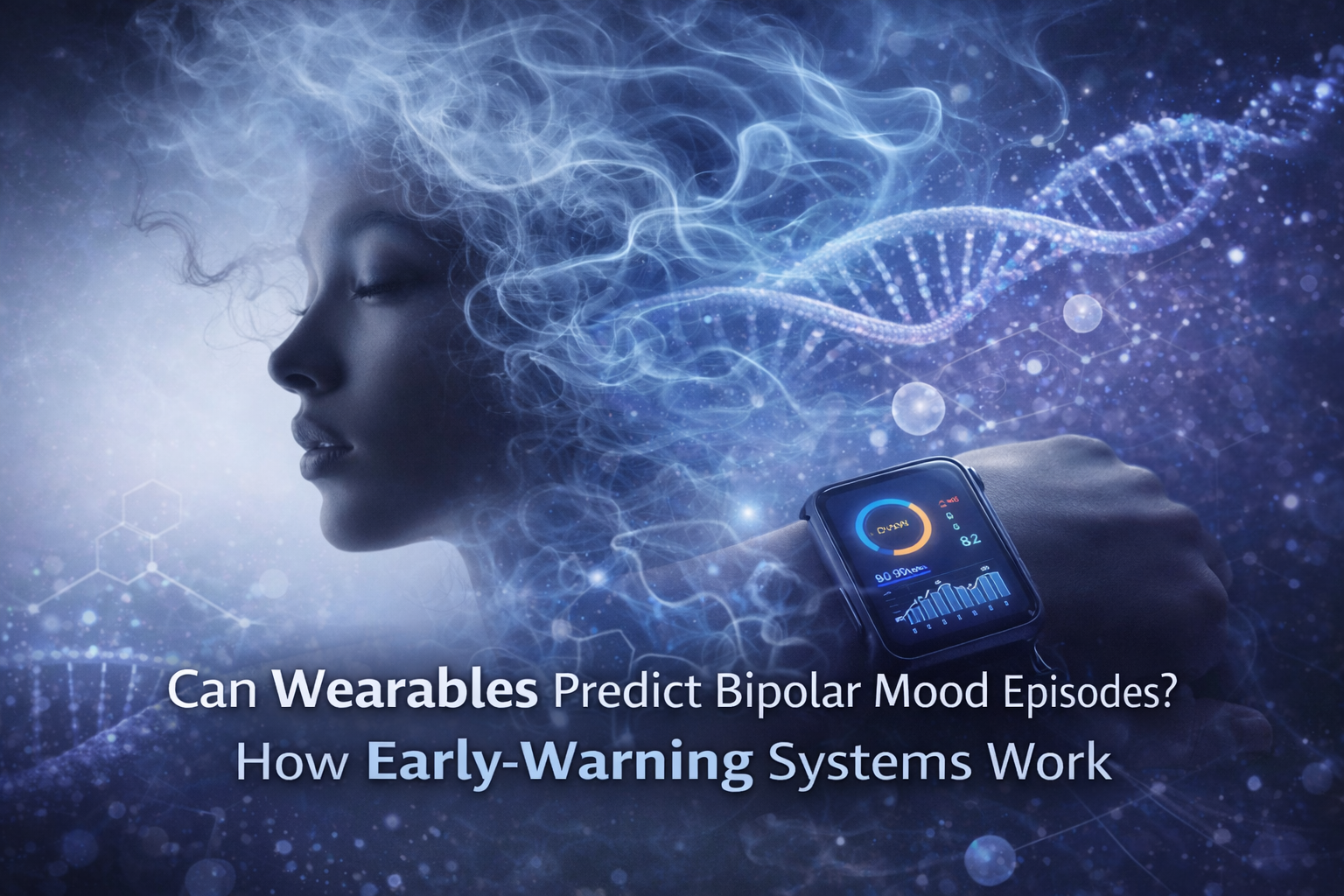
Bipolar disorder has long been defined by its unpredictability. Mood episodes often feel as though they arrive without warning, disrupting work, relationships and health. Over the past few years, that assumption has started to change. Advances in wearable technology, behavioural data analysis and artificial intelligence are pointing towards a future where bipolar mood episodes may be anticipated days or even weeks before they fully emerge.
This article explores how early‑warning systems for bipolar disorder work, what the science currently shows, where the limitations remain, and what this technology could realistically mean for people living with bipolar disorder.
Why Predicting Bipolar Episodes Matters
Relapse prevention is one of the most critical challenges in bipolar care. Research consistently shows that:
- Each untreated episode increases the likelihood of future episodes
- Earlier intervention reduces severity, hospitalisation risk and recovery time
- Many people only recognise an episode once it is already well underway
Traditional monitoring relies heavily on self‑reporting and clinical check‑ins, which are intermittent by nature. Wearable‑based systems aim to fill the gap between appointments by continuously tracking subtle biological and behavioural changes that precede mood shifts.
What Are Bipolar Early‑Warning Systems?
Early‑warning systems combine passive data collection with pattern recognition. Instead of asking someone how they feel, these systems observe how the body and behaviour change over time.
Most current models focus on identifying deviations from an individual’s personal baseline, rather than comparing users to population averages. This is important because bipolar disorder presents very differently from person to person.
Key components typically include:
- Wearable sensors (smartwatches, rings, fitness trackers)
- Smartphone‑based behavioural data
- Machine‑learning models trained on longitudinal mood data
- Alerts or insights delivered to users and, in some cases, clinicians
What Wearables Actually Measure
Modern wearables collect far more than step counts. Several physiological signals are particularly relevant to bipolar disorder.
Sleep Patterns
Sleep disruption is one of the strongest predictors of both manic and depressive episodes.
Wearables can detect:
- Reduced total sleep time
- Delayed sleep onset
- Increased night‑time awakenings
- Irregular sleep‑wake timing
In many cases, sleep changes appear before mood symptoms become subjectively noticeable.
Heart Rate and Heart Rate Variability (HRV)
Heart rate variability reflects autonomic nervous system balance. Research suggests:
- Reduced HRV is often associated with depressive states
- Elevated resting heart rate and reduced variability may precede manic episodes
Continuous tracking allows trends to be identified that would be invisible in a clinical snapshot.
Activity and Energy Levels
Accelerometer data provides insight into:
- Sudden increases in movement and restlessness
- Gradual withdrawal and reduced activity
- Changes in daily routine consistency
These patterns can mirror emerging hypomania or depression.
Circadian Rhythm Stability
Bipolar disorder is closely linked to circadian rhythm disruption. Wearables can model rhythm regularity by combining sleep, light exposure and activity data, highlighting destabilisation early.
The Role of Smartphones and Behavioural Data
Beyond wearables, smartphones add another layer of predictive signal:
- Typing speed and error rates
- Communication frequency (calls, messages)
- App usage patterns
- GPS‑based mobility trends
For example, increased late‑night phone use combined with reduced sleep and rising activity may signal an approaching manic episode, while reduced communication and mobility may suggest depressive relapse.
How AI Turns Data Into Predictions
Raw data alone is not useful without interpretation. Machine‑learning models are trained using:
- Historical mood episode timelines
- Clinician‑confirmed diagnoses
- Longitudinal sensor data
Over time, algorithms learn which combinations of changes reliably precede episodes for a specific individual. This personalised approach is what differentiates modern systems from generic mood trackers.
Rather than producing a diagnosis, most systems aim to generate risk signals, such as:
- “Elevated risk of mood instability in the next 7 days”
- “Sleep‑related relapse risk increasing”
This allows preventative action before symptoms escalate.
What the Research Currently Shows
Emerging studies indicate that early‑warning systems can:
- Identify manic or depressive risk up to 1–2 weeks in advance
- Improve medication adherence when feedback is shared with clinicians
- Reduce hospitalisation rates in monitored cohorts
- Increase patient insight into personal relapse triggers
Importantly, predictive accuracy improves significantly after several months of continuous data collection, as individual baselines become clearer.
Limitations and Ethical Considerations
Despite the promise, these systems are not without challenges.
False Positives and Anxiety
Over‑alerting can create unnecessary stress if users receive warnings that do not result in episodes. Well‑designed systems prioritise trend‑based alerts rather than single‑day anomalies.
Data Privacy
Mental health data is highly sensitive. Robust encryption, local data storage options and transparent consent processes are essential.
Clinical Integration Gaps
Many tools exist outside formal healthcare systems. Without clinician involvement, alerts may not lead to timely treatment adjustments.
Not a Replacement for Care
Early‑warning systems support — but do not replace — psychiatric care, therapy or medication.
What This Means for the Future of Bipolar Care
As technology matures, early‑warning systems may become a standard part of long‑term bipolar management. Potential future developments include:
- Integration with electronic health records
- Automated medication review prompts
- Personalised lifestyle intervention suggestions
- Clinician dashboards for proactive outreach
The broader shift is from reactive care to preventative care — intervening before episodes fully emerge rather than managing the aftermath.
Key Takeaways
- Bipolar mood episodes are often preceded by measurable biological and behavioural changes
- Wearables can detect sleep, heart rate, activity and rhythm disruptions early
- AI enables personalised prediction rather than one‑size‑fits‑all tracking
- Early‑warning systems show strong promise but are still evolving
- Used correctly, they empower earlier intervention and improved stability
Predicting bipolar episodes is no longer science fiction. While no system is perfect, the combination of wearables and intelligent data analysis represents one of the most meaningful advances in bipolar care in decades — offering insight, agency and the possibility of fewer severe episodes over time.