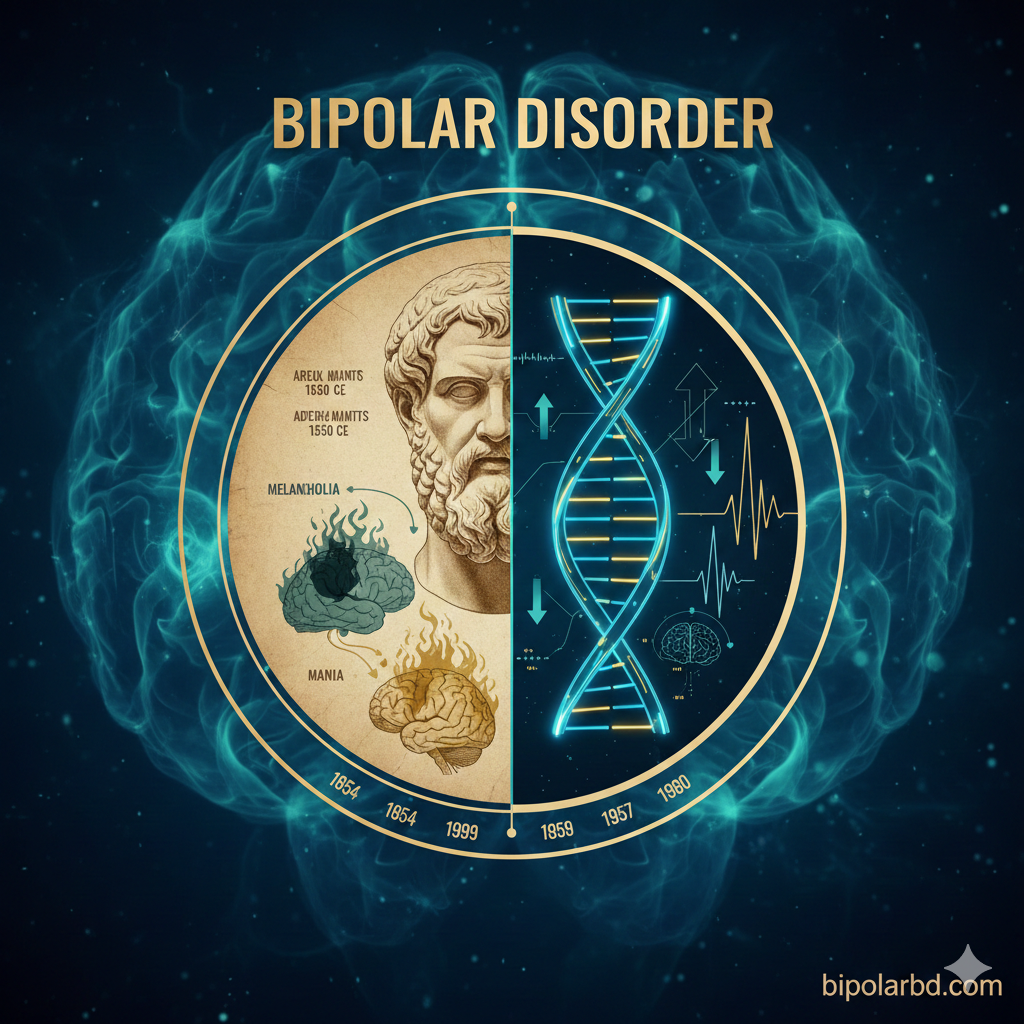
The history of Bipolar Disorder is not a single “discovery” in a lab. Instead, it is a 2,000-year clinical evolution. To understand who “created” the diagnosis, we have to look at the three specific men who defined its features, its cycles, and finally, its modern name.
1. The Ancient Concept: Aretaeus of Cappadocia (~150 CE)
While the Greeks knew of “Mania” and “Melancholia,” they treated them as unrelated conditions. Aretaeus of Cappadocia was the first to accurately document the “spectrum.” He observed that patients often transitioned from a state of sorrow to one of extreme joy and laughter.
He was the first to decide that these were not two diseases, but one. However, his work was largely ignored for nearly 1,700 years until the dawn of modern psychiatry in France.
2. The 1854 French Dispute: Defining the “Features”
In 1854, the clinical features we recognise today—the cycling between moods and the periods of stability—were formalised during a legendary rivalry. Two French psychiatrists presented their findings to the Académie Impériale de Médecine in Paris just weeks apart.
- Jean-Pierre Falret: He described folie circulaire (circular insanity). Falret’s contribution was the most accurate because he was the first to note “lucid intervals” (periods of normal mood). He also established that the condition was hereditary.
- Jules Baillarger: He described folie à double forme (dual-form insanity). He focused on the immediate shift from one state to another.
- The Conflict: Baillarger accused Falret of plagiarism, a scandal that dominated French medicine for years.However, Falret is generally credited as the true pioneer of modern bipolar definitions because of his focus on the genetic and cyclic nature of the illness.
3. Emil Kraepelin: The Great Unifier (1899)
If the French found the symptoms, the German psychiatrist Emil Kraepelin created the medical entity. In the 6th edition of his landmark textbook, Kraepelin unified all mood disorders into one category: Manic-Depressive Insanity.
Kraepelin’s “Creation” included three vital features:
- The Biological Basis: He argued the cause was constitutional (biological) rather than purely emotional.
- The “Outcome” Theory: He noted that unlike other forms of “insanity,” manic-depressive patients recovered their full cognitive function between episodes.
- The Mixed State: He was the first to document that mania and depression could happen simultaneously. You can read more about how these symptoms manifest today here.
4. Karl Leonhard: The Man Who Named “Bipolar” (1957)
By the 1950s, the term “Manic-Depression” had become a “catch-all” that included people who only suffered from depression (unipolar). Karl Leonhard decided this was scientifically inaccurate.
- The Genetic Split: Leonhard’s research showed that people who experienced both highs and lows (Bi-polar) had a much higher rate of family history than those who stayed at one end of the spectrum (Uni-polar).
- The Rebrand: He coined the term “Bipolar” specifically to highlight this genetic and biological distinction.
5. 1980: The DSM-III Decides the Modern “Lines”
The American Psychiatric Association (APA) eventually caught up with Leonhard’s research. In 1980, with the release of the DSM-III, “Manic-Depressive Illness” was officially removed.
Why did they decide on this change?
- Precision: To distinguish the condition from clinical depression.
- Stigma: To remove the word “maniac,” which had become a derogatory social term.
- Sub-typing: This era led to the distinction between Bipolar I and Bipolar II, based on the severity of the “highs” (mania vs. hypomania).
Timeline of the Bipolar Diagnosis
| Year | Milestone | Key Figure | Core Insight |
| ~150 CE | First Concept | Aretaeus of Cappadocia | First to link mania and depression as one illness. |
| 1854 | Clinical “Features” | Jean-Pierre Falret | Defined the “Circular” nature and hereditary links. |
| 1899 | Medical Entity | Emil Kraepelin | Unified all mood psychoses under “Manic-Depressive.” |
| 1957 | The Term “Bipolar” | Karl Leonhard | Separated Bipolar from Unipolar based on genetics. |
| 1980 | Official Adoption | APA (DSM-III) | Manic Depression officially became Bipolar Disorder. |
Summary: Who is the “True” Creator?
While Aretaeus saw it first and Leonhard named it, Emil Kraepelin is the man who truly “decided” what Bipolar was. He took it from a collection of symptoms and turned it into a formal medical diagnosis based on biology, heredity, and the course of the illness.
To better understand the causes of the disorder that Kraepelin first identified, exploring the modern neurological and genetic links is the next step in the journey of this diagnosis.